



If you are a candidate searching for the WAEC Chemistry Practical Specimen for 2024, you have come to the right place. We aim to provide our audience with accurate information to help them study effectively and pass the Waec Exam.
The WAEC Chemistry practical tests you on titration and on identifying a salt (qualitative analysis). Past specimens, such as the 2024 one below, show the apparatus and solutions supplied. Practise reading a burette, recording your titre and testing for ions, since specific solutions change from year to year.
What is a WAEC Chemistry practical specimen?
It is the list of apparatus and materials supplied to each candidate for the practical. It includes standard laboratory equipment plus specific solutions, labelled A, B and C, which you use in the experiment. The exact substances and concentrations change each year, so use past ones as practice, not as a prediction.
What apparatus do candidates use?
In the 2024 instructions, each candidate needed:
- A 50 cm³ burette and a 20 cm³ or 25 cm³ pipette
- The usual titration apparatus and a conical flask
- A spatula, filtration apparatus, a beaker, a boiling tube and four test tubes
- Methyl orange indicator, a glass rod, a wash bottle with distilled water
- A burning splint, a watch glass, a Bunsen burner and droppers
- Reagents for qualitative tests (dilute NaOH, HCl, HNO₃ and H₂SO₄, silver nitrate, barium chloride, aqueous ammonia, lime water and litmus paper)
What was in the 2024 specimen?
| Label | Contents |
|---|---|
| A | Potassium manganate(VII) solution, 1.58 g per dm³ |
| B | Iron(II) sulfate solution, 5.58 g per dm³ |
| C | A 1:1 mixture by mass of sodium carbonate and lead(II) nitrate |
Taken from the 2024 instructions. Not a prediction for any other year. The materials point to a titration between A and B, and qualitative analysis of C.
How should I prepare for the titration?
- Rinse the burette with the solution it will hold, and check there are no air bubbles.
- Read the meniscus at eye level, and record readings to two decimal places.
- Repeat until you get concordant titres (close values).
- Show your table clearly, then your working.
How should I prepare for the qualitative analysis?
Learn the tests for common ions (for example, the reactions of lead(II) and carbonate), and note every observation and inference. Practise with the reagents listed above.
Is the Chemistry practical different for GCE (private) candidates?
Yes. Private candidates usually write the Alternative to Practical paper. It is written, not hands-on, but it uses the same ideas. In the 2026 second series, it was on 5 October. legit
FAQs
Where can I get the current WAEC Chemistry practical specimen?
From your school or WAEC. Be careful with sites selling “questions and answers” before an exam, because many are false.
Is the specimen the same every year?
No. The solutions, concentrations and tasks change.
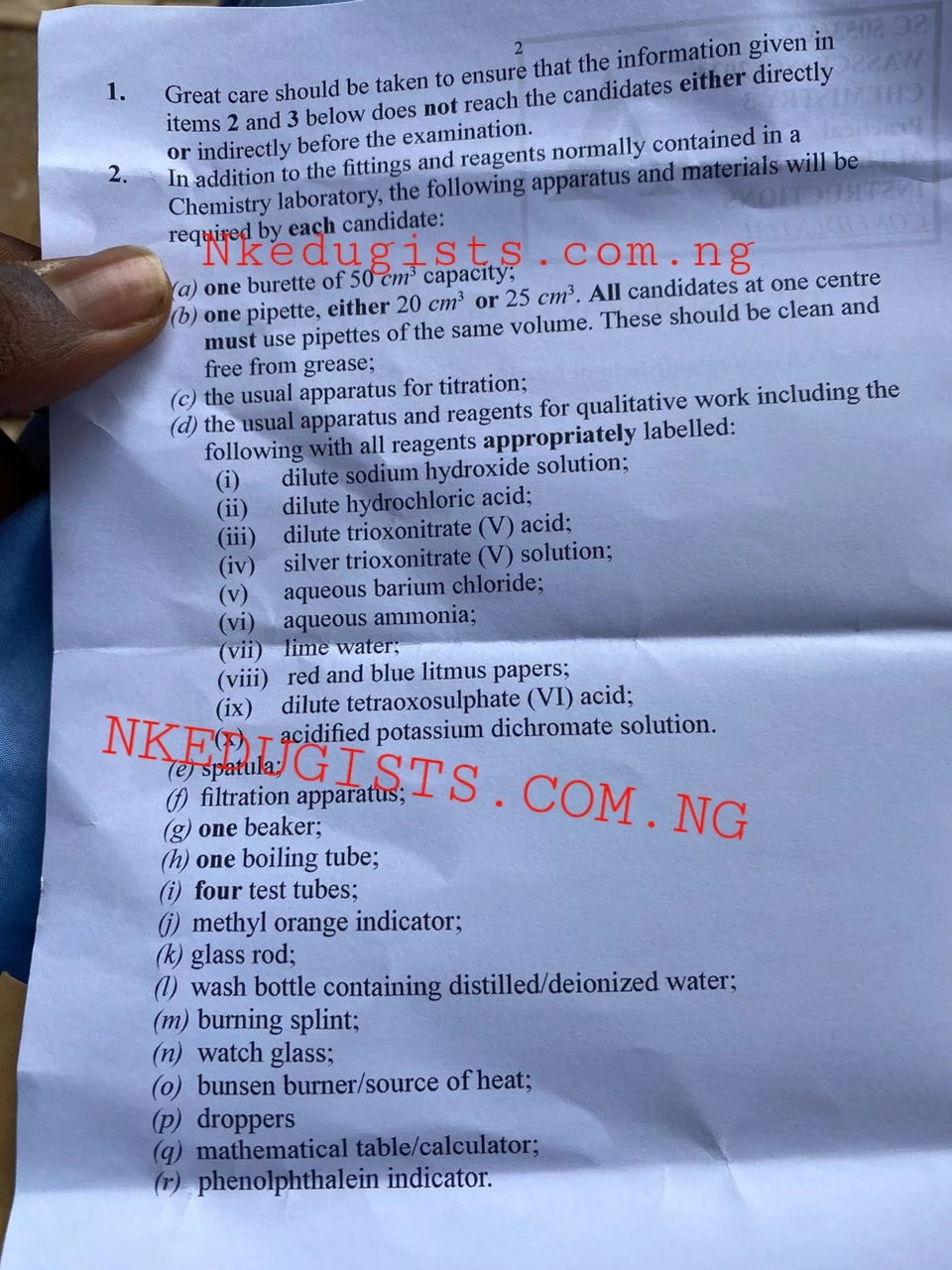
1. Great care should be taken to ensure that the information given in items 2 and 3 below does not reach the candidate either directly or indirectly before the examination.
2. In addition to the fittings and reagents normally found in a chemistry laboratory, the following apparatus and materials will be required by each candidate:
(a) One burette of 50 cm3 capacity;
(b) One pipette, either 20 cm3 or 25 cm3. (All candidates at one centre must use pipettes of the same volume. These should be clean and free from grease)
(c) The usual apparatus for titration;
(d) The usual apparatus and reagents for qualitative work including the following with all reagents appropriately labelled;
(i) Dilute sodium hydroxide solution;
(ii) Dilute hydrochloric acid;
(iii) Dilute trioxonitrate (V) Acid
(iv) Silver trioxonitrate (V) Solution;
(v) aqueous barium chloride;
(vi) aqueous ammonia;
(vii) Lime water;
(viii) Red and blue litmus paper
(ix) Dilute tetraoxosulphate (VI) acid;
(x) acidified tetraoxosulphate (vi) acid.
(e) Spatula;
(f) Filtration apparatus;
(g) One beaker
(h) One boiling tube;
(i) Four test tubes;
(j) Methyl orange as indicator;
(k) Glass rod;
(l) Wash bottle containing distilled/deionized water;
(m) Burning splint;
(n) Watch glass;
(o) Bunsen burner/source of heat;
(p) Droppers;
(q) Mathematical table/calculator.
3. Each candidate should be supplied with the following, where ‘n’ is the candidate’s serial number
(a) 150 cm3 of potassium tetraoxomagnate (vii) solution, in a corked flask or bottle labelled ‘An’. These should all be the same containing 1.58g per dm3 of KMNO4 solution.
(b) 150cm3 of FeSO4 solution in a corked flask or bottle labelled ‘Bn’.These should all be the same containing 5.58g of FeSO4 per dm3 solution.
(c) One spatulaful of sodium trioxocarbonate (iv) and one spatulaful of lead (ii) nitrate in a specimen bottle labelled ‘Cn’. The component of the mixture should be in the ratio 1:1 by mass. This must be the same for all candidates.
4. In all cases, more materials may be issued if required
5. The actual concentrations of A and B must be stated on the Supervisors report form. The candidates will assume that the concentrations are exactly as stated in the question paper
6. It should be noted that schools are not allowed to amend the information provided on the question paper or substitute any substance/solution for those specified in these instructions.
ARRANGEMENT AND 2024 SERIAL NUMBERS OF WAEC CANDIDATES
7. The laboratory places should be numbered serially and the candidates should be allotted these places strictly in the order of their index numbers. The number of every specimen supplied to each candidate should be the same as his or her serial number.
8. If a candidate is absent, his or her serial number should not be allotted to another candidate
9. If the candidate is divided into a number of sets, the serial numbers should be continued through the sets, so that no serial number is repeated
10. At the beginning of the examination, it should be ensured that the candidates record their serial number as well as their index numbers on the front page of their answer booklets.
Conducting the WAEC Chemistry Practical Test
- The following announcements should be made to the candidates at the beginning of the examination
“The examiner does not want you to waste your time because you cannot proceed with an experiment. Any candidate, therefore, who cannot get on with the experiment after spending 15 minutes on it, may come to me and ask for help”
- The Chemistry teacher should be allowed to give a hint to a candidate who is unable to proceed with an experiment.
- The following regulations must be strictly adhered to:
- No hint should be announced to the candidates as a whole
- A candidate who is unable to proceed and requires assistance must come up to you and state his or her difficulty. The candidate should be told that the Examiner will be informed of any assistance given in any way.
- A note must be made on the Report Form, of any kind of assistance given to any candidate, with the name and index number of the candidate.
- Report Forms are provided separately, on which you are required to state the following:
- Detailed information about the apparatus where necessary
- Any particular difficulties experienced by any candidate, especially if the Examiner would be unable to discover these from the scripts
- Any departure from the specified items which could not be avoided
- Any assistance is given to the candidate under the regulations explained in 5 above
- In cases where several sets of apparatus are provided for a question and specific information about the apparatus is required by the Examiner, each piece of apparatus about which the information is required, and which may differ slightly for different candidates, must be clearly marked with letter A, B, C, etc. and the corresponding information must be clearly reported, showing which apparatus was supplied to which candidates. The candidate should be instructed to record these letters in their scripts
- A completed Report Form must be enclosed in each envelope of scripts.
Just be free to write to us in the comment box below or join our forum where answers will be posted for free in other not to make the wrong mistake but achieve success in the end. Thanks for reading.

3 Comments
Thanks.practical questions sir
nice
pls I need waec 2024 chemistry