


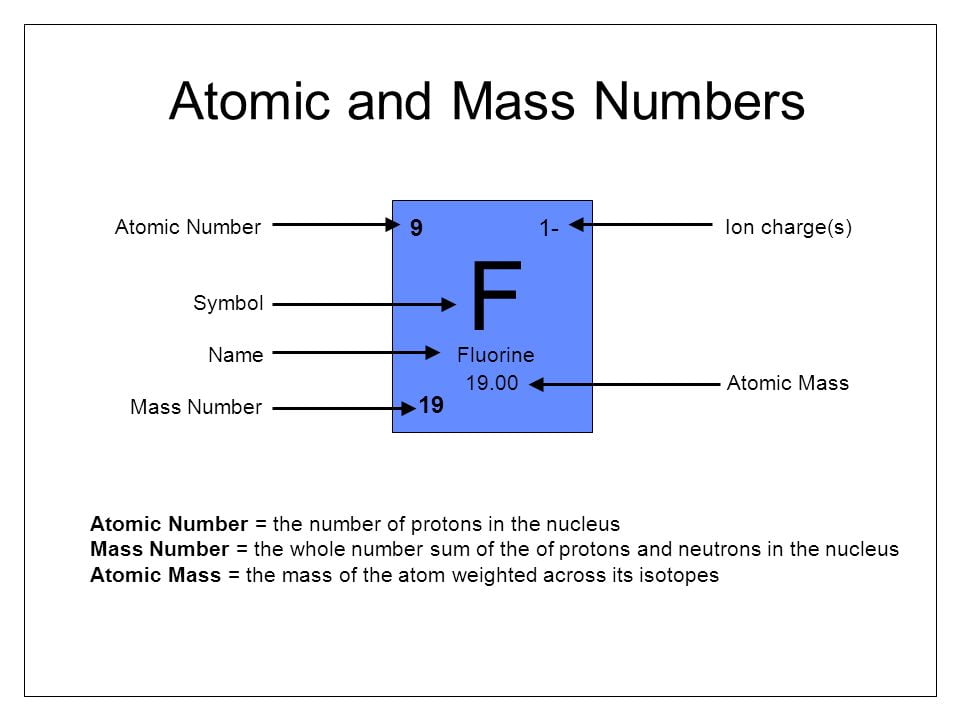
Solution to Relative Atomic mass have been provided. Can you calculate the mass number of an element if you are given only its atomic number? The answer is no. You need to know the number of neutrons as well.
The atomic number of an element tells you the number of protons in its atom. In a neutral atom, the number of electrons is also equal to the number of protons.
However, the mass number is calculated by adding the number of protons and neutrons together.
Mass number = Number of protons + Number of neutrons
In this article, we provide solutions to selected Chemistry questions on atomic structure, isotopes, relative atomic mass and related calculations.
These questions cover topics students may encounter when studying the nature of matter and preparing for Chemistry examinations.
Chemistry Questions on Isotopes and Relative Atomic Mass
Try answering the following questions before checking the solutions.
1. How many electrons are in a neutral atom with mass number 19 and atomic number 9?
(a) 8
(b) 9
(c) 10
(d) 19
2. What is the mass number of an element if its atom contains 10 protons, 10 electrons and 12 neutrons?
(a) 32
(b) 22
(c) 20
(d) 10
3. 14.8 g of salt dissolved in enough distilled water to make 250 cm³ of solution gives a concentration of 0.80 mol dm⁻³. Calculate the molar mass of the salt.
(a) 13.5 g mol⁻¹
(b) 18.5 g mol⁻¹
(c) 47.4 g mol⁻¹
(d) 74.0 g mol⁻¹
4. How many atoms are there in one mole of hydrogen gas?
[Avogadro’s constant, (N_A = 6.02 \times 10^{23}) mol⁻¹]
(a) (1.2 \times 10^{23})
(b) (6.0 \times 10^{23})
(c) (1.2 \times 10^{24})
(d) (6.0 \times 10^{24})
5. Neutral atoms of neon with atomic number 10 have the same number of electrons as which of the following ions?
(a) O²⁻
(b) Ca²⁺
(c) K⁺
(d) Mg²⁺
6. The electronic configuration of an atom is 2, 8, 8, 2. What is the atomic number of the element?
(a) 10
(b) 15
(c) 18
(d) 20
7. Which of the following ions have the same number of electrons as neon?
[Atomic numbers: F = 9, Ne = 10, Na = 11, Mg = 12, Al = 13]
I. Na⁺
II. Mg²⁺
III. Al³⁺
IV. F⁻
(a) I and II only
(b) II, III and IV only
(c) I, II and III only
(d) I, II, III and IV
8. What is the mass of (6.02 \times 10^{24}) atoms of magnesium?
[Mg = 24; Avogadro’s constant = (6.02 \times 10^{23}) atoms mol⁻¹]
(a) 240 g
(b) 24 g
(c) 2.4 g
(d) 0.24 g
9. An element X has a relative atomic mass of 16.2 and contains two isotopes. One isotope has a mass number of 16 and a relative abundance of 90%, while the other has a mass number of m and a relative abundance of 10%. Calculate the value of m.
(a) 14
(b) 12
(c) 18
(d) 16
Solutions to Questions on Isotopes and Relative Atomic Mass
Solution 1: Number of Electrons in a Neutral Atom
Question: How many electrons are in a neutral atom with mass number 19 and atomic number 9?
(a) 8 (b) 9 (c) 10 (d) 19
Correct answer: (b) 9
Explanation:
The atomic number of an element is equal to the number of protons in its atom.
For a neutral atom:
Number of electrons = Number of protons
Since the atomic number is 9:
Number of electrons = 9.
Solution 2: Calculating the Mass Number
Question: What is the mass number of an element if its atom contains 10 protons, 10 electrons and 12 neutrons?
(a) 32 (b) 22 (c) 20 (d) 10
Correct answer: (b) 22
Explanation:
The mass number is the sum of the number of protons and neutrons.
Mass number = Number of protons + Number of neutrons
= 10 + 12
= 22
The number of electrons is not included when calculating the mass number.
Solution 3: Calculating Molar Mass
Question: 14.8 g of salt dissolved in enough distilled water to make 250 cm³ of solution gives a concentration of 0.80 mol dm⁻³. Calculate the molar mass of the salt.
(a) 13.5 g mol⁻¹
(b) 18.5 g mol⁻¹
(c) 47.4 g mol⁻¹
(d) 74.0 g mol⁻¹
Correct answer: (d) 74.0 g mol⁻¹
Explanation:
Given:
- Mass of salt = 14.8 g
- Volume = 250 cm³
- Concentration = 0.80 mol dm⁻³
First, convert the volume from cm³ to dm³:
Solution 4: Number of Atoms in One Mole of Hydrogen Gas
Question: How many atoms are there in one mole of hydrogen gas?
[Avogadro’s constant = (6.02 x 10^23) mol⁻¹)
(a) (1.2 x 10^23
(b) (6.0 x 10^23
(c) (1.2 x 10^24
(d) (6.0 x 10^24
Correct answer: (c) 1.2 x 10^24
Explanation:
Hydrogen gas exists as a diatomic molecule, H₂. This means that each hydrogen molecule contains two hydrogen atoms.
Solution 5: Number of Electrons in Neon and Other Ions
Question: Neutral atoms of neon with atomic number 10 have the same number of electrons as which of the following ions?
(a) O²⁻
(b) Ca²⁺
(c) K⁺
(d) Mg²⁺
Correct answers: (a) O²⁻ and (d) Mg²⁺
Explanation:
Neon has an atomic number of 10. Therefore, a neutral neon atom has 10 electrons.
Calculate the electrons in each ion:
- O²⁻: 8 + 2 = 10 electrons.
- Ca²⁺: 20 − 2 = 18 electrons.
- K⁺: 19 − 1 = 18 electrons.
- Mg²⁺: 12 − 2 = 10 electrons.
Therefore, both O²⁻ and Mg²⁺ have the same number of electrons as neon.
Note: The original question is not suitable as a single-answer multiple-choice question because both options (a) and (d) are correct.
Solution 6: Finding the Atomic Number from Electronic Configuration
Question: The electronic configuration of an atom is 2, 8, 8, 2. What is its atomic number?
(a) 10 (b) 15 (c) 18 (d) 20
Correct answer: (d) 20
Explanation:
The atomic number of a neutral atom is equal to its total number of electrons.
Add the electrons in all the shells:
2 + 8 + 8 + 2 = 20
Therefore, the atomic number is 20.
Solution 7: Ions with the Same Number of Electrons as Neon
Question: Which of the following ions have the same number of electrons as neon?
I. Na⁺
II. Mg²⁺
III. Al³⁺
IV. F⁻
Correct answer: (d) I, II, III and IV
Explanation:
Neon has 10 electrons.
Calculate the number of electrons in each ion:
- Na⁺: 11 − 1 = 10 electrons.
- Mg²⁺: 12 − 2 = 10 electrons.
- Al³⁺: 13 − 3 = 10 electrons.
- F⁻: 9 + 1 = 10 electrons.
All four ions have 10 electrons, just like neon.
Therefore, the correct answer is (d).
Solution 8: Calculating the Mass of Magnesium Atoms
Question: What is the mass of (6.02 \times 10^{24}) atoms of magnesium?
[Mg = 24; Avogadro’s constant = (6.02 \times 10^{23}) atoms mol⁻¹]
(a) 240 g (b) 24 g (c) 2.4 g (d) 0.24 g
Correct answer: (a) 240 g
Explanation:
Given:
- Number of magnesium atoms = 6.02 x 10^24
- Avogadro’s constant = 6.02 x 10^23
- Molar mass of magnesium = 24 g mol⁻¹
First, calculate the number of moles:
Next, calculate the mass:
Therefore, the correct answer is (a) 240 g.
Solution 9: Calculating the Mass of an Isotope
Question: An element X has a relative atomic mass of 16.2 and contains two isotopes. One isotope has a mass number of 16 and a relative abundance of 90%, while the other has a mass number of m and a relative abundance of 10%. Calculate m.
(a) 14 (b) 12 (c) 18 (d) 16
Correct answer: (c) 18
Explanation:
The formula for calculating relative atomic mass is:
[
A_r = \frac{\sum(\text{Isotopic mass}\times\text{Relative abundance})}{100}
]
Given:
- Relative atomic mass = 16.2
- First isotope mass = 16
- First isotope abundance = 90%
- Second isotope mass = m
- Second isotope abundance = 10%
Substitute the values:
Therefore, the correct answer is (c) 18.
Summary of Correct Answers
| Question | Correct answer |
|---|---|
| 1 | (b) 9 |
| 2 | (b) 22 |
| 3 | (d) 74.0 g mol⁻¹ |
| 4 | (c) 1.2 × 10²⁴ |
| 5 | (a) O²⁻ and (d) Mg²⁺ |
| 6 | (d) 20 |
| 7 | (d) I, II, III and IV |
| 8 | (a) 240 g |
| 9 | (c) 18 |
Important: In Question 5, two options are correct, so it should not be marked as a single-answer question.
