


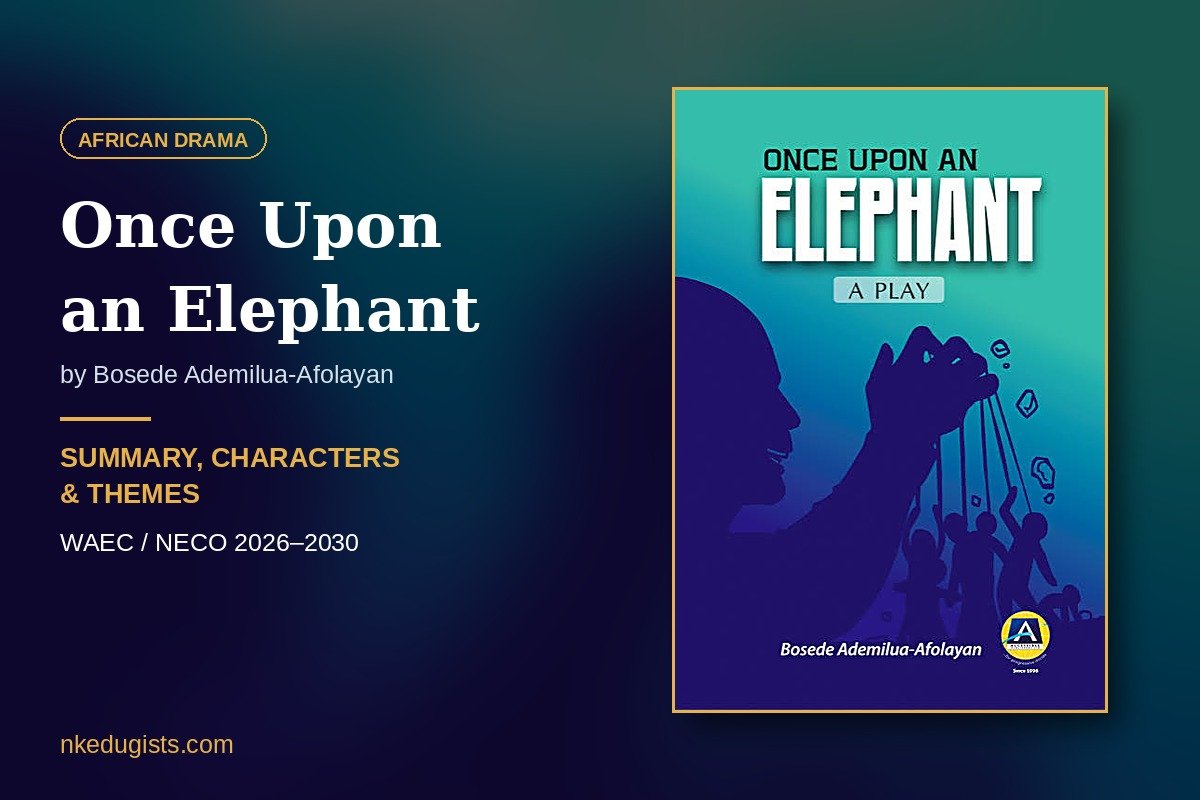
Check out the Once Upon an Elephant Summary. Once Upon an Elephant is a 2015 Nigerian play by Bosede Ademilua-Afolayan. It tells the story of Ajanaku (Olaniyonu), a man who becomes king through trickery and then rules as a tyrant, and of the people who finally bring him down. Using the style of a Yoruba folktale, the play criticises dictatorship, corruption and the abuse of power.
The play is on the WAEC Literature-in-English list for 2026–2030 as an African Drama text. This guide gives you the playwright, background, plot summary, setting, scene-by-scene summary, characters, themes, literary devices, practice questions and FAQs.
Once Upon an Elephant Summary
| Detail | Information |
|---|---|
| Title | Once Upon an Elephant |
| Playwright | Bosede Ademilua-Afolayan |
| Year published | 2015 |
| Publisher | Kraft Books Limited, Ibadan |
| Genre | Drama (political and socio-cultural play) |
| Setting | An unnamed traditional Yoruba village |
| Structure | Fourteen scenes |
| Main character | Ajanaku (Olaniyonu) |
| Exam use | WAEC African Drama text, 2026–2030 |
About the Playwright of Once Upon an Elephant
Bosede Funke Ademilua-Afolayan is a Nigerian playwright, poet and scholar in the Department of English at the University of Lagos. Her academic interests include comparative drama, African literature, women’s studies, creative writing and Nollywood studies.
Her works explore social and political issues, particularly the abuse of power, cultural identity, gender and the struggles of ordinary people. Her play Look Back in Gratitude was published in 2013, while Once Upon an Elephant followed in 2015.
The playwright drew inspiration for Once Upon an Elephant from Yoruba oral tradition and the image of the proud elephant. She also used the characters to examine the behaviour of African political leaders who cling to power and surround themselves with impressive titles while neglecting the people they govern.
Background to the Play of Once Upon an Elephant
Once Upon an Elephant is a political and socio-cultural drama published by Kraft Books Limited in Ibadan in 2015. The play is set in an unnamed traditional Yoruba community.
It examines what happens when a ruler ignores established succession practices, manipulates traditional institutions and uses public office for personal gain.
The story centres on Olaniyonu, who takes the title Ajanaku after becoming king. With Serubawon’s assistance, he obtains the throne through manipulation rather than legitimate succession. His desire for absolute power eventually turns him into a tyrant.
The play draws on a Yoruba folktale about an arrogant elephant whose pride and abuse of power lead to its downfall. Through this traditional story, the playwright comments on dictatorship, corruption and political leadership in contemporary African society.
Plot Summary of Once Upon an Elephant
The play opens with Serubawon preparing Ajanaku, also known as Olaniyonu, for kingship while King Akinjobi is seriously ill. However, the king is still alive, and Ajanaku is not the rightful first son. Baderin, the eldest son, has a stronger traditional claim to the throne.
Odejimi and the other elders question the decision to prepare Ajanaku for the throne before the king’s death. Serubawon, however, is determined to make Ajanaku king. He attempts to influence the kingmakers through gifts and manipulation. He also performs rites on Ajanaku, including the Olubori and Ijedodo rites, hoping to make him immortal, and he does this without consulting the other elders.
Meanwhile, Odekunle, a young man of the village, is in love with Desola, Serubawon’s daughter. They hope to marry, but Desola has an unsettling dream that suggests trouble ahead.
Following King Akinjobi’s death, Ajanaku is installed as the new king. During his coronation, he compares himself to an elephant and boasts about his strength and ability to crush anyone who opposes him. His speech reveals his pride and desire to rule without restraint.
His behaviour soon confirms the fears of those who opposed his appointment. When two women bring a land dispute before him, he takes the disputed land for himself instead of delivering a fair judgment.
Iya Agba, the former king’s senior wife, enters the palace and challenges Ajanaku’s conduct. She speaks in proverbs and warns that his pride will bring about his downfall. Ajanaku dismisses her as a mad woman and orders her out of the palace.
Iya Agba later returns and questions Ajanaku’s legitimacy. She hints that Serubawon knows the truth about his parentage. Ajanaku is disturbed by her accusation, but Serubawon tells him to ignore her.
Ajanaku’s cruelty also affects neighbouring communities. Representatives of Oguno Village approach him for protection against invaders. Rather than help them, he demands increased tribute. His refusal exposes his lack of concern for the welfare of the people who depend on his leadership.
The conflict becomes more personal when Ajanaku uses his position and force to take Omoyeni away from Delani, the man she loves. He makes Omoyeni his wife despite her feelings for Delani.
The situation becomes even worse when Ajanaku’s guards attack Odekunle and Desola at a kolanut farm. Desola is taken away and sexually assaulted by Ajanaku. Odekunle is left distressed by what has happened.
Desola later reveals the incident to her parents. The disclosure creates a serious conflict because her father, Serubawon, has been helping Ajanaku carry out the Ijedodo ritual, which is intended to give the king supernatural protection and immortality. Desola is revealed to be the sixth victim required for the ritual.
Another important secret emerges through Iya Agba. She explains that Serubawon and Adebisi, one of King Akinjobi’s younger wives, had an affair. Ajanaku is therefore Serubawon’s biological son, not the late king’s. This also means that Desola is Ajanaku’s half-sister, which makes his crime against her even more shocking. Serubawon had helped discredit Iya Agba through false accusations so that she would be removed from the palace and unable to expose the truth.
Omoyeni also reveals that the child she is carrying belongs to Delani, not Ajanaku. Her disclosure further exposes the king’s abuse of women and the private suffering hidden behind his public authority.
As the Jobele festival approaches, Iya Agba and her allies prepare to end Ajanaku’s reign. At the festival, Desola, Odekunle and their supporters confront the king. Through their plan, Desola is freed from the ritual’s hold, and Ajanaku loses the supernatural power that has sustained his tyranny.
Serubawon’s part in the conspiracy is also exposed, and his actions bring about his own downfall. The community is left to choose a new ruler, while Omoyeni and Delani are free to be together. The ending suggests the possibility of a new beginning after the destruction of corrupt leadership.
Setting and Its Significance of Once Upon an Elephant Summary
The unnamed Yoruba village
The main setting is an unnamed traditional Yoruba community. It represents a society in which kingship, customs, elders and communal responsibilities play important roles.
The village also provides a setting for the playwright’s criticism of political dictatorship and corruption.
The king’s palace
The palace is the centre of political authority. It is where Ajanaku makes decisions, receives visitors and exercises his power.
Rather than protecting the people, he turns the palace into a place where injustice and intimidation take place.
Odejimi’s house
Odejimi’s home provides a contrast to the palace. It is associated with family life, traditional values and opposition to Ajanaku’s questionable rise to power.
The kolanut farm
The kolanut farm is where Ajanaku’s guards seize Desola and Odekunle. The incident marks a major turning point in the play because it brings the consequences of Ajanaku’s abuse of power directly into the lives of the younger generation.
Iya Agba’s house
Iya Agba’s house becomes a place where important secrets are revealed and plans against Ajanaku are discussed. It is also a meeting point for characters seeking justice.
The village square and Jobele festival ground
The village square is used for public ceremonies, including Ajanaku’s coronation. The Jobele festival provides the setting for the final confrontation and the end of his rule.
Scene-by-Scene Summary of Once Upon an Elephant
The play is presented in fourteen scenes. The following outlines the main developments in sequence.
Scene One: The Plot to Install Ajanaku
Serubawon begins preparations to install Ajanaku as king while King Akinjobi is still seriously ill. Odejimi and the other elders question the decision because Ajanaku is not the first son and the king is still alive. Serubawon attempts to influence the kingmakers with gifts.
Scene Two: Desola and Odekunle’s Relationship
Desola and Odekunle meet and discuss their love and plans for marriage. Desola shares a troubling dream about their future. Their relationship is threatened by the political tension in the community.
Scene Three: Ajanaku’s Coronation
After King Akinjobi’s death, Ajanaku is installed as king. He compares himself to an elephant and boasts of his power. Odejimi is unhappy with his arrogance and disrespect for tradition.
Scene Four: Odejimi’s Opposition
At home, Odejimi discusses the coronation with his wife, Iyale. He regards Ajanaku’s appointment as a betrayal of tradition. Iyale offers a different view of the people’s reluctance to challenge wrongdoing.
Scene Five: Ajanaku’s First Acts of Tyranny
Ajanaku handles a land dispute brought before him by two women. Instead of giving a fair judgment, he takes control of the disputed land. Iya Agba enters the palace and warns him through proverbs that his pride will lead to his downfall.
Scene Six: Iya Agba Challenges the King
Iya Agba returns to confront Ajanaku. She questions his legitimacy and hints that Serubawon knows the truth about his biological father. Ajanaku dismisses her claims and orders her out.
Scene Seven: The Appeal from Oguno Village
Representatives of Oguno Village ask Ajanaku for protection against invaders. He refuses to help unless they pay increased tribute. His response exposes his greed and lack of concern for neighbouring communities.
Scene Eight: Desola Is Attacked
Desola and Odekunle meet at a kolanut farm. Ajanaku’s guards attack them, seize Desola and assault Odekunle. Ajanaku sexually assaults Desola. Odekunle later tells his friends what happened.
Scene Nine: Desola Reveals the Truth
Preparations are being made for Desola and Odekunle’s marriage, but Desola is distressed. She tells her parents what happened at the kolanut farm. Her disclosure brings the consequences of Ajanaku’s actions into Serubawon’s own family.
Scene Ten: Serubawon Learns About Desola
Serubawon confronts Ajanaku over what happened to his daughter. Ajanaku reveals that Desola has become the sixth victim of the Ijedodo ritual that Serubawon designed for him.
Scene Eleven: Omoyeni Visits Iya Agba
Omoyeni visits Iya Agba and discusses Ajanaku’s questionable parentage. She also reveals that Delani, rather than Ajanaku, is the father of her unborn child. The disclosure exposes another example of Ajanaku’s abuse of power.
Scene Twelve: The Family Secrets Are Exposed
Odekunle, Iyale, Demoke and others seek Iya Agba’s help for Desola. Iya Agba confronts Serubawon and reveals his affair with Adebisi, the late king’s younger wife. Serubawon admits that he is Ajanaku’s biological father.
Scene Thirteen: The Plan Against Ajanaku
The characters learn more about the Ijedodo ritual and the danger it poses to Desola. Serubawon explains the ritual’s connection with Ajanaku’s quest for immortality. The approaching Jobele festival becomes the opportunity to end the king’s reign.
Scene Fourteen: The Fall of Ajanaku
During the Jobele festival, Desola, Odekunle, Iya Agba and their allies carry out their plan. Desola embraces Ajanaku, while Odekunle uses a specially prepared red cloth to break the power sustaining the king. Ajanaku falls, Serubawon’s conspiracy is brought to an end, and the community looks towards choosing a new ruler. Omoyeni and Delani are also free to be together.
Once Upon an Elephant Major Characters and Characterization
1. Ajanaku (Olaniyonu)
Ajanaku is the central antagonist of the play. He is the younger son of King Akinjobi and becomes king through Serubawon’s manipulation.
Character traits:
- Ambitious and power-hungry.
- Arrogant and boastful.
- Cruel and oppressive.
- Greedy and selfish.
- Disrespectful of tradition.
- Determined to maintain power.
Ajanaku’s comparison of himself to an elephant reveals his belief that he is too powerful to be challenged. His seizure of land, treatment of neighbouring communities and abuse of women show how he uses kingship to satisfy personal desires.
2. Serubawon
Serubawon is a palace priest, medicine man and influential kingmaker. He is responsible for helping Ajanaku become king.
Character traits:
- Manipulative and deceitful.
- Ambitious and selfish.
- Disloyal to King Akinjobi.
- Secretive and dishonest.
- Morally compromised.
His affair with Adebisi and his role in Ajanaku’s installation reveal the extent of his betrayal. His actions eventually destroy his own family, especially when Desola becomes a victim of the ritual he prepared.
3. Iya Agba
Iya Agba is the senior wife of the late King Akinjobi. Her real name is Omofadeke Adunni. She is falsely accused of infidelity and removed from the palace.
Character traits:
- Wise and courageous.
- Truthful and outspoken.
- Patient and determined.
- Strong and resourceful.
- Protective of the community.
Although some people regard her as mad, she knows the truth about Ajanaku’s parentage and Serubawon’s betrayal. She plays a major role in exposing the conspiracy and bringing Ajanaku down.
4. Desola
Desola is Serubawon and Demoke’s daughter. She is in love with Odekunle and hopes to marry him.
Character traits:
- Loving and gentle.
- Innocent and vulnerable.
- Courageous.
- Resilient.
Her suffering reveals the cruelty of Ajanaku’s rule. Because Serubawon is also Ajanaku’s father, she is Ajanaku’s half-sister, a fact that makes the crime against her even more disturbing. However, she becomes an important part of the plan that ends his power.
5. Odekunle
Odekunle is a young man of the village and Desola’s lover.
Character traits:
- Loving and devoted.
- Courageous.
- Loyal.
- Determined.
He is deeply affected by what happens to Desola but does not abandon her. He later works with Iya Agba and the others in the plan against Ajanaku.
6. Odejimi
Odejimi is one of the respected elders and kingmakers in the community. He opposes Ajanaku’s questionable installation.
Character traits:
- Principled.
- Courageous.
- Traditional.
- Honest.
- Concerned about good leadership.
He represents people who refuse to support injustice even when powerful individuals try to influence them.
7. Omoyeni
Omoyeni becomes Ajanaku’s wife against her will, although she loves Delani.
Character traits:
- Strong-willed.
- Secretive.
- Determined.
- Loyal to her true feelings.
Her revelation that Delani is the father of her unborn child exposes Ajanaku’s abuse of women and the difference between public appearance and private truth.
8. Delani
Delani is the man Omoyeni loves. Ajanaku uses his power to take her away from him.
He represents love and personal choice in contrast with Ajanaku’s coercive behaviour.
9. King Akinjobi
King Akinjobi is the former ruler of the community and Ajanaku’s publicly recognised father. His illness and death create the succession crisis that Serubawon exploits.
10. Adebisi
Adebisi is one of King Akinjobi’s younger wives. Her secret relationship with Serubawon leads to Ajanaku’s birth and becomes central to the revelation about his true parentage.
11. Demoke
Demoke is Serubawon’s wife and Desola’s mother. She is affected by the consequences of her husband’s secret actions and her daughter’s suffering.
12. Iyale
Iyale is Odejimi’s wife. She discusses the political situation with her husband and later helps bring people together to seek Iya Agba’s assistance.
13. Ogundele
Ogundele is one of the village elders and kingmakers who take part in the discussions about Ajanaku’s appointment. His role shows how elders can be pressured or influenced when power is at stake.
14. Odegbami
Odegbami is another elder who participates in discussions about Ajanaku’s rule. He sometimes tries to explain the actions of the king and the pressure surrounding the community.
15. Baderin
Baderin is King Akinjobi’s eldest son and the rightful successor according to the traditional order of succession. Ajanaku’s installation bypasses his claim.
16. Gbeleyi
Gbeleyi is a representative of Oguno Village who challenges Ajanaku after the king refuses to help his community. His experience reveals the serious consequences of Ajanaku’s cruelty.
Other Supporting Characters
- Yosola: Desola’s friend who becomes involved in the events surrounding her suffering.
- Yele, Lere and Dele: Friends who support Odekunle after the attack on Desola.
- The kingmakers and guards: Help reveal how traditional authority can be manipulated or used to enforce oppression.
Major Themes in Once Upon an Elephant
1. Corruption and Abuse of Power
This is one of the central themes of the play. Ajanaku uses his position as king to satisfy his personal desires rather than serve the community.
For example, he takes control of land brought before him for judgment instead of resolving the dispute fairly. He also demands increased tribute from Oguno Village before agreeing to help its people.
The playwright shows that leadership becomes destructive when rulers place personal interests above public responsibility.
2. Tyranny and Dictatorship
Ajanaku represents a dictator who believes that nobody should challenge his authority.
His boastful comparison of himself to an elephant shows his belief that he can crush anyone who opposes him. He intimidates people, ignores criticism and uses force to maintain control.
The play warns against leaders who treat public office as personal property.
3. Betrayal and Deception
Betrayal is central to the events of the play. Serubawon betrays King Akinjobi by having an affair with Adebisi and secretly arranging for his biological son to become king.
He also helps spread false accusations against Iya Agba to protect his secret.
His actions show how personal ambition and dishonesty can destroy families and institutions.
4. Tradition and Legitimate Succession
The play examines the importance of traditional institutions and the dangers of manipulating them.
Ajanaku is installed despite the objections of elders and the existence of Baderin, the rightful first son. Serubawon uses his influence to interfere with the traditional succession process.
The playwright does not suggest that every tradition is beyond question. Rather, she shows how traditions can be abused when individuals manipulate them for selfish purposes.
5. Resistance and Collective Action
The play demonstrates that oppression can be challenged when people unite.
Iya Agba refuses to remain silent despite being discredited and excluded from the palace. Odejimi also maintains his opposition to Ajanaku’s illegitimate rule.
At the end, Desola, Odekunle, Iya Agba and their allies work together to bring Ajanaku’s reign to an end.
6. Gender Oppression and the Abuse of Women
The female characters experience different forms of injustice.
Ajanaku forces Omoyeni into marriage despite her love for Delani. He also sexually assaults Desola, treating her as an object in his quest for supernatural power.
Iya Agba is falsely accused and removed from the palace because she threatens to expose the truth.
Through these women, the playwright examines how political and traditional power can be used to control and silence women.
7. Pride and the Consequences of Ambition
Ajanaku’s pride makes him believe that he is invincible. He adopts the name Ajanaku and presents himself as a ruler whose power cannot be challenged.
His desire for immortality through the Ijedodo ritual shows how far his ambition has gone.
His downfall demonstrates that excessive pride and unchecked ambition can destroy the person who possesses them.
8. Family Secrets and Illegitimacy
The revelation that Serubawon is Ajanaku’s biological father changes the audience’s understanding of the succession crisis. It also means that Desola, Serubawon’s daughter, is Ajanaku’s half-sister.
The secret affair between Serubawon and Adebisi, together with the false accusation against Iya Agba, explains how Ajanaku’s true identity was concealed.
The playwright uses this family secret to connect private betrayal with public political corruption.
9. Justice and Accountability
Ajanaku initially escapes accountability because he controls the palace and uses his authority to silence opposition.
However, Iya Agba and her allies eventually expose his wrongdoing. His downfall shows that powerful people should not be above justice.
The ending also suggests that the community must choose a new ruler who respects its welfare and traditions.
Literary Devices and Dramatic Techniques
1. Symbolism
The elephant is the most important symbol in the play. It represents excessive power, pride, arrogance and tyranny.
Ajanaku adopts the elephant’s name because he wants people to see him as powerful and untouchable. However, the elephant also becomes a symbol of a ruler whose pride leads to his downfall.
2. Allegory
The play works as a political allegory. Although its events take place in a traditional Yoruba village, the characters and their actions represent wider political realities.
Ajanaku represents dictators, while Serubawon represents political collaborators who help corrupt leaders gain and retain power.
3. Foreshadowing
Desola’s troubling dream about her future marriage foreshadows the suffering that later affects her relationship with Odekunle.
Iya Agba’s repeated warnings about Ajanaku’s downfall also prepare the audience for the final confrontation.
4. Irony
There is situational irony in Serubawon’s role in the Ijedodo ritual. He helps Ajanaku carry out the ritual without knowing that his own daughter will become its sixth victim.
It is also ironic that Ajanaku, who presents himself as an invincible elephant, eventually falls through the actions of those he has oppressed.
5. Proverbs and Oral Tradition
Iya Agba uses proverbs and traditional expressions to communicate her warnings. Her language reflects Yoruba oral culture and allows her to criticise the king indirectly.
The playwright uses this technique to connect traditional storytelling with modern political criticism.
6. Allusion
The play alludes to a Yoruba folktale about an arrogant elephant that is tricked into its downfall by a clever tortoise.
This story provides a background for understanding Ajanaku’s character and the meaning of the title.
7. Characterisation
The playwright reveals characters through their speech, decisions and relationships.
Ajanaku’s boastful speeches reveal his arrogance, while Odejimi’s refusal to support the questionable coronation reveals his principles. Serubawon’s deception reveals his selfish ambition.
8. Contrast
The play contrasts Ajanaku with Odejimi and Iya Agba.
Ajanaku represents corruption and oppression, while Odejimi and Iya Agba represent resistance, truth and traditional responsibility.
9. Dramatic Irony
The audience gradually learns the truth about Ajanaku’s parentage before Ajanaku fully understands the implications of Iya Agba’s accusations. This creates tension around his identity and the legitimacy of his kingship.
10. Stage Directions and Visual Imagery
The playwright uses stage directions, costumes, entrances, exits and ceremonial activities to communicate meaning.
The final Jobele festival scene, for example, uses the characters’ appearance, the dirge and the red cloth to create a dramatic climax.
Significance of the Title: Once Upon an Elephant
The title refers to the elephant in Yoruba oral tradition and to Ajanaku, who adopts the elephant’s name as a symbol of his strength and authority.
The elephant represents a ruler who believes that nobody can challenge him. Ajanaku behaves in this manner by intimidating his subjects, taking land and using his authority to satisfy personal desires.
However, the traditional story also presents the elephant as a proud creature whose arrogance makes it vulnerable to defeat.
The title therefore reflects the rise and fall of Ajanaku. It also warns leaders that power without restraint can lead to destruction.
Lessons from the Play
- Leaders should serve the people rather than use public office for personal gain.
- Political power should not be obtained through bribery, manipulation or betrayal.
- Traditional institutions should not be controlled by selfish individuals.
- People should speak against injustice instead of remaining silent.
- Collective action can challenge oppression.
- Pride and excessive ambition can lead to failure.
- Dishonesty can destroy families and communities.
- Women deserve dignity, protection and the freedom to make personal choices.
- Leaders must be accountable for their actions.
- A society needs honesty, fairness and responsible leadership to remain stable.
WAEC Literature-in-English Questions and Answers For Once Upon an Elephant
Objective Questions
1. Who helps Ajanaku to become king?
A. Odejimi
B. Odekunle
C. Serubawon
D. Baderin
Answer: C. Serubawon
2. What is Ajanaku’s original name?
A. Olaniyonu
B. Baderin
C. Delani
D. Odekunle
Answer: A. Olaniyonu
3. Who is the rightful first son of King Akinjobi?
A. Ajanaku
B. Serubawon
C. Ogundele
D. Baderin
Answer: D. Baderin
4. Who is Desola’s lover?
A. Delani
B. Odekunle
C. Odejimi
D. Ogundele
Answer: B. Odekunle
5. What does Ajanaku use to represent his power?
A. Elephant
B. Lion
C. Eagle
D. Leopard
Answer: A. Elephant
6. Who is Iya Agba?
A. Ajanaku’s sister
B. Serubawon’s wife
C. The late king’s senior wife
D. Desola’s friend
Answer: C. The late king’s senior wife
7. What is the name of the ritual associated with Ajanaku’s quest for immortality?
A. Jobele
B. Coronation
C. Egungun
D. Ijedodo
Answer: D. Ijedodo
8. Who is Ajanaku’s biological father?
A. King Akinjobi
B. Serubawon
C. Odejimi
D. Odegbami
Answer: B. Serubawon
9. Who is the father of Omoyeni’s unborn child?
A. Delani
B. Ajanaku
C. Serubawon
D. Odejimi
Answer: A. Delani
10. Which festival provides the setting for the final confrontation?
A. New Yam Festival
B. Harvest Festival
C. Jobele Festival
D. Coronation Festival
Answer: C. Jobele Festival
11. Which character consistently challenges Ajanaku’s legitimacy?
A. Demoke
B. Omoyeni
C. Iyale
D. Iya Agba
Answer: D. Iya Agba
12. What does Ajanaku’s character mainly represent?
A. Responsible leadership
B. Political dictatorship
C. Religious tolerance
D. Communal development
Answer: B. Political dictatorship
13. Who is Omoyeni’s true lover?
A. Odekunle
B. Serubawon
C. Delani
D. Odejimi
Answer: C. Delani
14. Which character represents resistance to Ajanaku’s questionable rule among the elders?
A. Serubawon
B. Odejimi
C. Adebisi
D. Demoke
Answer: B. Odejimi
15. What is one major message of the play?
A. Power should remain in one family
B. Leaders should rule without criticism
C. Tradition should always be abandoned
D. Abuse of power eventually brings consequences
Answer: D. Abuse of power eventually brings consequences
Once Upon an Elephant Essay Questions and Answer Points
1. Discuss Ajanaku’s character as a tyrannical ruler in Once Upon an Elephant.
Different Answers Provided Pick any of your choice.
- He obtains the throne through manipulation.
- He boasts of his strength by comparing himself to an elephant.
- He takes disputed land for himself.
- He refuses to help Oguno Village without increased tribute.
- He forces Omoyeni into marriage.
- He abuses Desola.
- His actions eventually lead to his downfall.
2. Examine the role of Serubawon in Ajanaku’s rise and fall.
Different Answers Provided Pick any of your choice.
- He prepares Ajanaku for kingship.
- He manipulates the kingmakers.
- He helps conceal Ajanaku’s true parentage.
- He betrays King Akinjobi through his affair with Adebisi.
- He creates the Ijedodo ritual.
- His own daughter becomes a victim of the ritual.
- His secrets are exposed, bringing about his downfall.
3. Discuss the importance of Iya Agba in the play.
Different Answers Provided Pick any of your choice.
- She is the late king’s senior wife.
- She is falsely accused and removed from the palace.
- She knows the truth about Serubawon and Ajanaku.
- She challenges Ajanaku’s legitimacy.
- She uses proverbs to warn him.
- She helps expose the conspiracy.
- She contributes to the plan that ends Ajanaku’s rule.
4. Examine the theme of corruption and abuse of power in the play.
Different Answers Provided Pick any of your choice.
- Serubawon manipulates the succession process.
- Ajanaku uses bribery and intimidation to secure support.
- Ajanaku takes disputed land.
- He demands excessive tribute from Oguno Village.
- He uses his position to control women’s lives.
- The community suffers because of his selfish leadership.
5. Discuss the significance of the elephant in the play.
Different Answers Provided Pick any of your choice.
- Ajanaku adopts the name of the elephant.
- The elephant represents strength and authority.
- It also symbolises arrogance and excessive pride.
- Ajanaku believes that nobody can challenge him.
- The Yoruba folktale provides a pattern for his eventual downfall.
- The title warns against the misuse of power.
6. How does the playwright present the position of women in the play?
Different Answers Provided Pick any of your choice.
- Iya Agba is falsely accused and excluded from the palace.
- Omoyeni is forced into marriage with Ajanaku.
- Desola suffers sexual violence.
- The women experience the consequences of male ambition and political power.
- Iya Agba, Desola and their allies also demonstrate courage and resistance.
- The play criticises the abuse of women and recognises their role in challenging injustice.
7. Explain how tradition influences the events in Once Upon an Elephant.
Different Answers Provided Pick any of your choice.
- The traditional order of succession is important to the dispute over the throne.
- Baderin is the rightful first son.
- Serubawon manipulates traditional institutions.
- The kingmakers disagree over Ajanaku’s appointment.
- Yoruba proverbs and oral storytelling shape the play’s language.
- The Jobele festival provides the setting for the final confrontation.
Frequently Asked Questions Once Upon an Elephant by Bosede Ademilua-Afolayan
Who wrote Once Upon an Elephant?
The play was written by Nigerian playwright and scholar Bosede Ademilua-Afolayan.
Is Once Upon an Elephant on the WAEC Literature syllabus for 2026–2030?
Yes. It is listed as an African Drama text for 2026–2030, together with The Marriage of Anansewa by Efua Sutherland. WAEC publishes the harmonized list of texts on its Nigeria website: WAEC Nigeria. Confirm the list in your school’s current syllabus.
When was Once Upon an Elephant published?
It was published in 2015.
What is Once Upon an Elephant about?
The play explores political corruption, dictatorship, betrayal, abuse of power and resistance through the story of Ajanaku, a ruler who obtains the throne through manipulation and eventually loses his power.
Who is Ajanaku?
Ajanaku, whose original name is Olaniyonu, is the younger son of King Akinjobi in the eyes of the community and the central antagonist of the play.
Who is Serubawon?
Serubawon is a palace priest, medicine man and kingmaker who helps Ajanaku become king. He is later revealed to be Ajanaku’s biological father.
Who is Iya Agba?
Iya Agba is the senior wife of the late King Akinjobi. She is falsely accused and excluded from the palace but later exposes the secrets surrounding Ajanaku’s parentage.
What does Ajanaku symbolise?
Ajanaku symbolises dictatorship, arrogance, excessive ambition and the abuse of political power.
What is the significance of the Ijedodo ritual?
The Ijedodo ritual is associated with Ajanaku’s attempt to obtain immortality. It reveals the extreme cruelty and moral corruption behind his desire to remain powerful.
What is the main theme of the play?
The major theme is the abuse of power and dictatorship. Other themes include betrayal, corruption, tradition, resistance, gender oppression and justice.
What is the significance of the title?
The title refers to the elephant in Yoruba oral tradition and symbolises Ajanaku’s pride and belief in his own invincibility. His eventual downfall reinforces the warning against excessive power and arrogance.
Conclusion about Once Upon an Elephant Summary
Once Upon an Elephant is a political drama that uses Yoruba oral tradition to examine the dangers of dictatorship, corruption and betrayal. Through Ajanaku’s rise and fall, Bosede Ademilua-Afolayan shows how leaders who ignore justice and the welfare of their people eventually face the consequences of their actions.
For WAEC candidates, the most important areas to understand are Ajanaku’s character, Serubawon’s role in the succession crisis, Iya Agba’s revelations, the symbolism of the elephant, the Ijedodo ritual and the play’s criticism of corrupt leadership.
Join the Nkedugists WhatsApp Channel to get updates as they are announced.
